Our Mines
Albion Stone extracts Portland Stone from its own underground mines on the Isle of Portland in Dorset. This gives us control over the stone from extraction through to manufacture and provides a reliable supply of different Portland Stone beds for architectural, construction and restoration projects.
Our move from open quarrying to underground mining has transformed the way Portland Stone is extracted. Mining reduces disruption at the surface and allows stone to be reached beneath roads, playing fields, churchyards and agricultural land that can remain in use above.
From quarrying to underground mining
Albion Stone began trial mining at Bowers Quarry in 2002, becoming the first company to mine Portland Stone commercially.
Moving underground required new machinery, specialist training and the development of completely new working methods. Albion Stone invested more than £1 million in research and development over a ten year period while establishing its mining operations. About Albion Stone Presentation records the scale of the investment and the challenges involved in introducing an entirely new extraction method to Portland.
Today, underground mining allows us to extract Portland Stone with much less disturbance to the surface than traditional open quarrying. Only a relatively small entrance is required to reach the stone beds beneath the island.
At Stonehills, agriculture can continue above the mine while extraction takes place below. Within the Jordans and Bowers complex, mining has allowed us to work beneath roads, playing fields and other community land.
Read more about the environmental benefits of underground Portland Stone mining.
How Portland Stone is mined
Albion Stone uses the room and pillar method to extract Portland Stone underground.
Sections of stone are removed to create working areas, while pillars of natural stone are left in place to support the mine roof. The layout and condition of the mine are regularly inspected as extraction progresses.
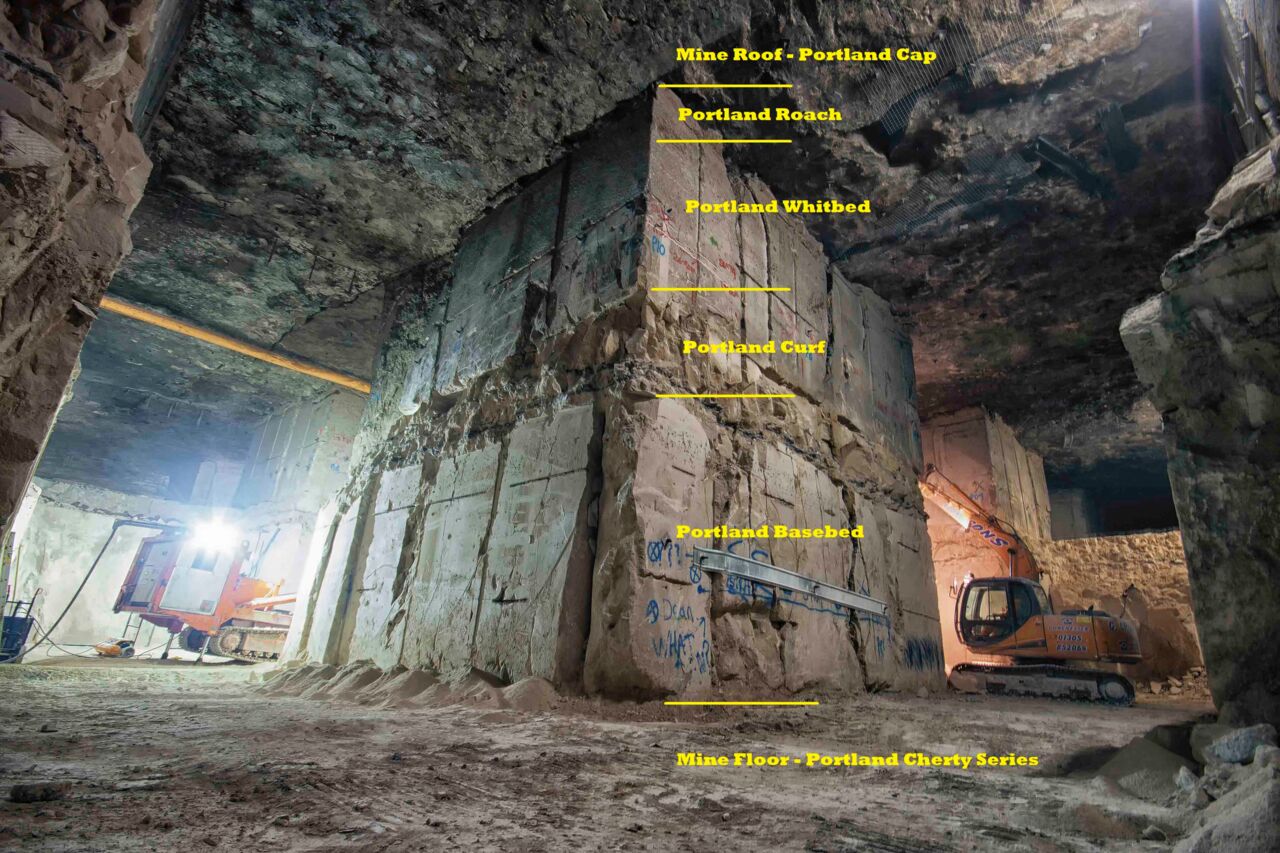
The Portland Stone sequence includes several distinct geological layers:
- Roach
- Whitbed
- Curf
- Basebed
The required stone bed is identified within the mining face before specialist machinery is used to cut and release the stone. Albion Stone Stone & Surfaces.pptx records working areas of up to nine metres high and six metres wide, with substantial pillars retained to support the roof.
Once released, the stone is inspected and divided into blocks suitable for lifting and transport. The blocks are then moved from the mine to our nearby Portland factory for sawing, machining and finishing.
Learn more about how Portland Stone is manufactured at our factory.
Jordans and Bowers Mine Complex
Mining began at Bowers Quarry in 2002, initially through a trial mine before expanding into the surrounding reserves.
Operations later extended into Jordans Mine and beneath neighbouring roads, playing fields and community areas. The Jordans and Bowers workings were successfully connected in November 2019, creating one combined underground mine complex.
The complex provides access to several established Portland Stone beds:
- Grove Whitbed®
- Fancy Beach Whitbed
- Jordans Whitbed
- Ostrea Patch Reef Whitbed
- Jordans Basebed
- Bowers Roach®
Grove Whitbed, Fancy Beach Whitbed and Jordans Whitbed are different visual classifications from the same geological bed. Testing carried out when extraction began at Jordans found no significant difference in technical performance between the cleaner and shellier sections of the Whitbed.
Stonehills Mine
Stonehills is the first Portland Stone mine developed independently of an existing quarry. Planning and enabling work carefully considered the surrounding landscape, wildlife and continued agricultural use of the land above.
Extraction began in 2021 and currently provides Stonehills Whitbed.
The mine demonstrates the reduced surface impact of underground extraction. A relatively small entrance provides access to the stone beds below while agriculture can continue across much of the land above. Internal Albion Stone material describes this approach as being similar to keyhole surgery for the island.
Responsible mining
Underground mining provides important environmental and operational benefits compared with open quarrying.
These include:
- Less disturbance to the surface landscape
- Continued use of land above the mine
- Access to stone beneath existing roads and community areas
- Reduced removal of surface material
- Greater control over the extraction process
- Improved working conditions through modern mining machinery
- A short journey from the mines to our Portland factory
We also use electrically powered equipment wherever practical and have replaced diesel generators with mains electricity at the Jordans and Bowers sites.
Learn more about our approach to carbon footprint and energy.
Safety and modern mining technology
Underground mining requires specialist training, careful planning and equipment designed for the working environment.
Albion Stone has invested in modern mining machinery to improve safety, accuracy and efficiency. This includes equipment that allows drilling, resin injection, roof bolting and bolt tightening to be completed from within a protected operator’s cab.
Our mining procedures form part of our occupational health and safety management system, which is certified to ISO 45001.
Read more about health and safety at Albion Stone.
From the mine to the finished stone
Owning and operating our mines provides Albion Stone with control over the source, selection and availability of its Portland Stone.
Our mining and production teams work together to match available blocks with project requirements. Block dimensions, geological characteristics and the intended application are considered before the stone enters production.
Typical samples are available for despatch, while larger range panels at Portland show the broader geological characteristics of each stone bed where architects and customers review the appearance of various Portland Stone beds.
Explore our complete range of Portland Stone, or contact Albion Stone to discuss block requirements, samples or a mine and factory visit.


As a fourth generation family business, Albion Stone takes pride in its knowledgeable and dedicated workforce. By combining traditional craftsmanship with modern manufacturing techniques, we produce Portland Stone of the highest quality while minimising our environmental impact.


