Heritage Portland Stone: Understanding the Geology Behind the Name
For many people, the name Heritage Portland Stone can create the impression that it refers to a separate bed of stone within the Isle of Portland's famous limestone deposits. In reality, Heritage Portland Stone is not a distinct geological bed at all. Instead, it is a classification that reflects the natural variation found within Portland Stone and the practical realities of modern extraction.
The geology of the Isle of Portland is complex and constantly changing. As shown in the Portland Cross Section, Albion Stone extracts Portland Stone from a nine-metre section within the Portland Stone Beds. This section comprises the Portland Whitbed, Mid-Tier and Portland Basebed.
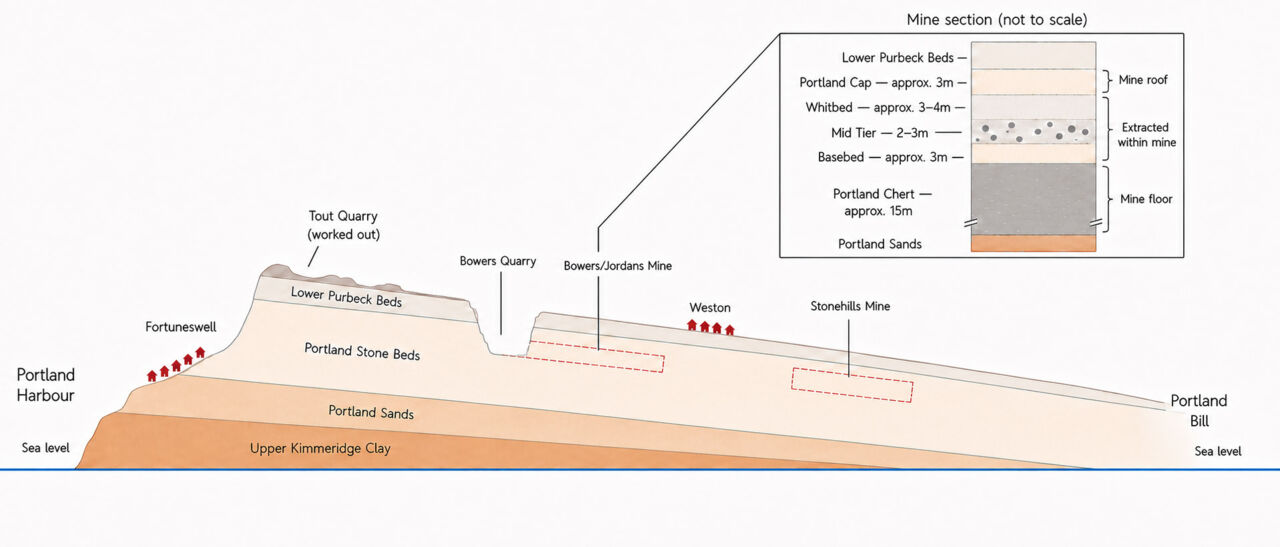
Of these three horizons, only the Whitbed and Basebed are extracted as dimension stone. The Mid-Tier is not worked as a saleable building stone. Instead, it is removed to gain access to the valuable Basebed beneath. Due to its high flint content and naturally fractured nature, the Mid-Tier is currently used as backfill within the mine.
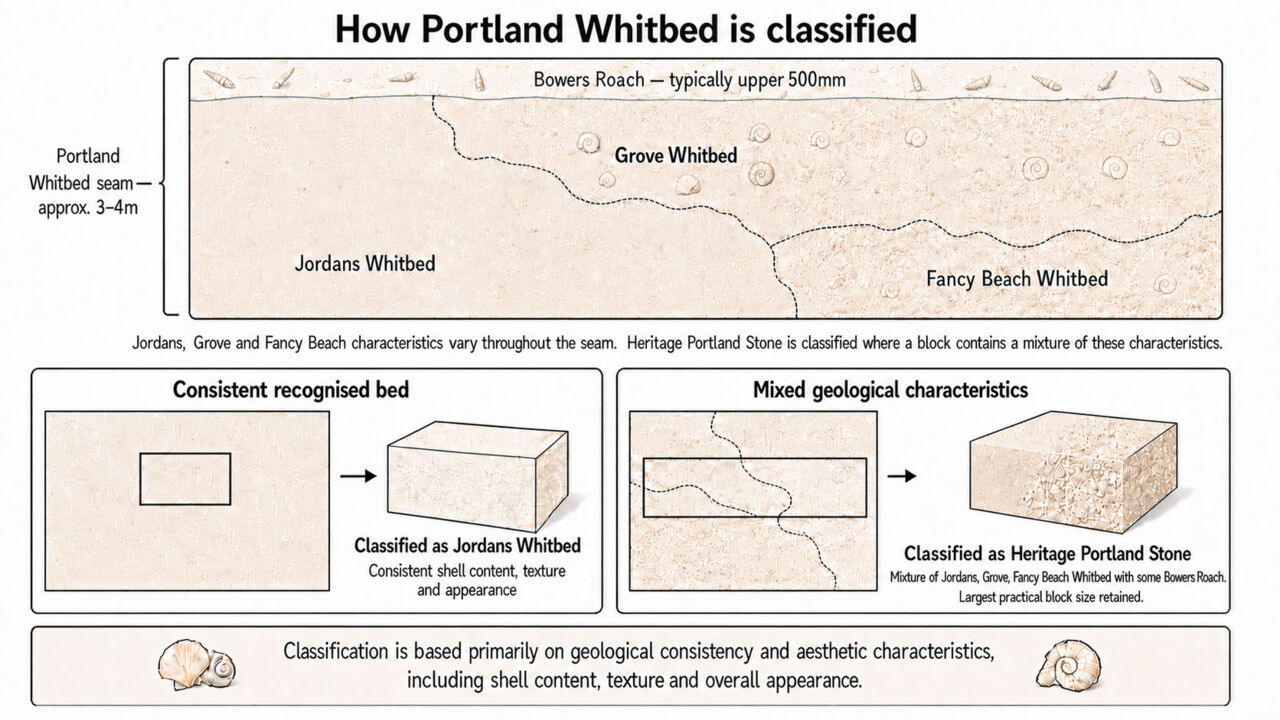
Within the Portland Whitbed, geology becomes even more variable. The Whitbed is typically three to four metres thick and contains the recognised classifications of Bowers Roach, Jordans Whitbed, Grove Whitbed and Fancy Beach Whitbed. However, as illustrated in the Portland Whitbed Division diagram, these are not neat, level beds extending uniformly throughout the mine.
Instead, the boundaries between these classifications undulate and change across the deposit. Every mining advance and every extraction face presents a different geological picture. In one area a block may be predominantly Jordans Whitbed, while elsewhere the same block could contain characteristics associated with Grove Whitbed, Fancy Beach Whitbed or Bowers Roach.
Albion Stone always aims to extract the largest, most consistent blocks possible. Where a block displays the characteristics of a recognised classification, it can be processed and sold as that specific Whitbed type. However, geology does not always cooperate.
Many blocks naturally contain a mixture of geological characteristics. While it would sometimes be possible to cut these blocks into smaller pieces to separate the different stone types, doing so would reduce block size, increase processing and create additional waste. In some cases, the benefit simply does not justify the loss of material.
Rather than forcing a geological classification that does not reflect the natural stone, Albion Stone leaves these blocks as large as practical and classifies them as Heritage Portland Stone.
Heritage Portland Stone is therefore not a newly discovered bed, nor is it a recent addition to the geology of Portland. It is simply a way of identifying blocks that contain a natural blend of Portland Whitbed characteristics, including varying proportions of Jordans Whitbed, Grove Whitbed, Fancy Beach Whitbed and, in some instances, Bowers Roach.
In many respects, this reflects how Portland Stone was historically supplied. Before the 1970s, stone was generally sold with far less emphasis on the detailed classifications commonly used today. As a result, many historic buildings contain a natural blend of Portland Stone characteristics rather than a single, tightly defined bed.
For conservation and restoration projects, Heritage Portland Stone can therefore provide an excellent geological match to buildings constructed before modern classification methods became standard practice hence the name ‘Heritage Portland Stone’.
Keeping blocks as large as possible also offers practical advantages. The stone is particularly well suited to projects requiring large format masonry, structural stonework and loadbearing applications where substantial block sizes are beneficial.
There are environmental benefits too. By reducing the need for additional cutting and processing, more of the original stone resource is retained and less waste is generated. This means Heritage Portland Stone is the most resource efficient and cost-effective ways of supplying Portland Stone.
Ultimately, Heritage Portland Stone is not about creating a new product. It is about recognising the natural geology of the Portland Whitbed and making use of the stone in a way that respects both the material and the island's long quarrying tradition. The result is a stone that is geologically authentic, historically appropriate and available in the largest practical block sizes that the mine can produce.
As a fourth generation family business, Albion Stone takes pride in its knowledgeable and dedicated workforce. By combining traditional craftsmanship with modern manufacturing techniques, we produce Portland Stone of the highest quality while minimising our environmental impact.