How Local Sourcing Can Reduce Transport Carbon by 89%
As the construction industry works towards reducing embodied carbon, much of the conversation focuses on the manufacturing processes used to produce building materials. However, a new independent study by Looper in partnership with the Mineral Products Association (MPA) highlights another major contributor to a project's carbon footprint that is often overlooked: transport emissions.
The study examines the carbon impact of transporting natural stone from different sourcing regions to construction projects in the UK. Its findings reinforce an important principle for sustainable construction. While natural stone is already one of the lowest carbon building materials available, the distance it travels can significantly affect its overall environmental impact.
For architects, developers and specifiers looking to reduce the embodied carbon of their projects, understanding the role of transport emissions is becoming increasingly important. When several natural stone options are technically suitable, choosing a locally sourced material can deliver substantial carbon savings before construction even begins.
Why Transport Emissions Matter in Construction
Embodied carbon assessments often focus on material extraction, manufacturing and installation. Yet transportation can account for a significant proportion of a building material's overall carbon footprint, particularly when products are imported from overseas.
According to the Looper and MPA study, transport emissions increase considerably as sourcing moves from local and UK supplied stone to European and global imports. The report highlights that reducing transport distances is one of the most effective ways to lower a project's embodied carbon.
This is especially relevant for natural stone, where multiple materials may offer similar performance characteristics but have very different supply chains and transport requirements.
Natural Stone Remains One of the Lowest Carbon Building Materials
Natural stone already delivers strong environmental credentials. The study notes that natural stone has an average manufacturing footprint of approximately 0.09 kgCO₂e per kilogram. By comparison, Albion Stone's Environmental Product Declaration (EPD) reports a figure of just 0.045 kgCO₂e per kilogram, around half the industry average, making it an even lower carbon choice than many commonly used construction materials.
Combined with exceptional durability, longevity and the ability to be reclaimed and reused, natural stone continues to be a popular choice for projects seeking long term sustainability.
However, the environmental benefits of natural stone can be enhanced even further through local sourcing and shorter transport routes.
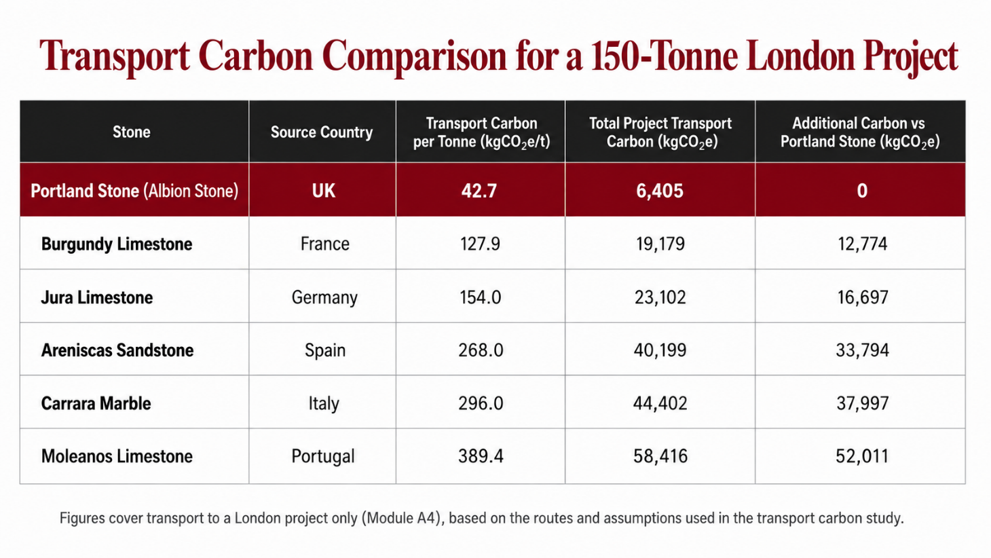
To illustrate the impact, we compared a typical London project requiring 150 tonnes of stone using the transport routes and carbon factors assessed within the Looper and MPA study.
Portland Stone vs Portuguese Moleanos Limestone
One of the most significant findings from the study relates to Portuguese Moleanos limestone, one of the most widely specified imported limestones in the UK market.
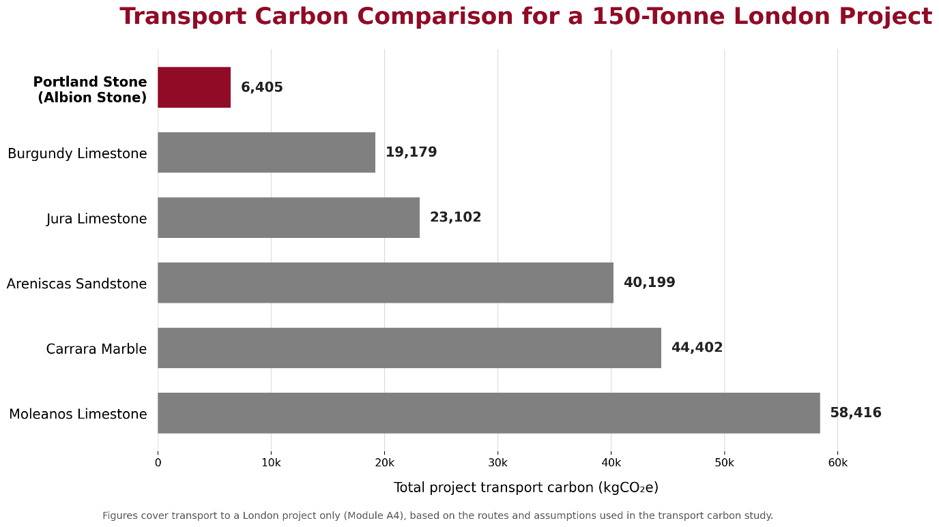
Using the transport routes analysed within the study, a typical London project requiring 150 tonnes of stone would generate approximately 58,416 kgCO₂e in transport emissions when supplied with Portuguese Moleanos limestone.
By comparison, the same project supplied with Portland Stone extracted from Albion Stone's mine in Dorset would generate approximately 6,405 kgCO₂e from transport.
This represents a saving of more than 52,000 kgCO₂e, with transport emissions around nine times higher for the imported Portuguese material.
What Does a Saving of 52,000 kgCO₂e Look Like?
Large carbon figures can be difficult to visualise, but the difference highlighted by the study is significant.
The transport carbon saving achieved by specifying Portland Stone instead of imported Portuguese limestone on a typical 150 tonne London project is comparable to a person flying from London to New York and back every week for an entire year.
This demonstrates how material selection decisions can make a measurable difference to a project's overall carbon footprint, even before construction activities commence.
The Benefits of Locally Sourced Stone
The advantages of local sourcing extend beyond comparisons with Portuguese limestone.
The report found that even Burgundy limestone from France, the lowest carbon imported example assessed, still generated almost three times the transport emissions associated with Portland Stone delivered to London.
The findings support a wider trend: as the distance between extraction and construction site increases, transport emissions rise accordingly. This reinforces the importance of considering logistics alongside aesthetics, performance and cost when selecting natural stone.
For projects in London, the South East and across the UK, Portland Stone benefits from a relatively short and direct supply chain. Extracted from Albion Stone's underground mine in Dorset and transported directly to site, Portland Stone avoids many of the extensive road freight and international shipping routes associated with imported stone products.
Understanding the Full Stone Supply Chain
The study also encourages project teams to think beyond simple labels such as "local" or "imported".
Understanding where stone is quarried, where it is processed and how it ultimately reaches site can reveal substantial differences in transport related emissions. In some cases, stone may be extracted in one country, transported elsewhere for processing and then shipped again to its final destination, increasing the overall carbon impact.
For architects and specifiers seeking low embodied carbon materials, analysing the full journey of a material can provide valuable insight into its true environmental performance.
Local Stone Can Play a Major Role in Reducing Embodied Carbon
The independent Looper and MPA study demonstrates that transport should not be treated as an afterthought when assessing embodied carbon. Reducing transport distance is one of the simplest and most effective ways to lower the environmental impact of construction materials.
For architects, developers and contractors working towards net zero and lower carbon construction, locally sourced Portland Stone provides a compelling option. By combining the inherently low manufacturing footprint of natural stone with a shorter, more efficient supply chain, project teams can make meaningful reductions in embodied carbon while benefiting from one of Britain's most iconic and durable building materials.
As a fourth generation family business, Albion Stone takes pride in its knowledgeable and dedicated workforce. By combining traditional craftsmanship with modern manufacturing techniques, we produce Portland Stone of the highest quality while minimising our environmental impact.