Limonitic Surface Deposits
In common with many different rock types, Portland Stone can contain trace quantities of naturally occurring iron distributed throughout its beds.
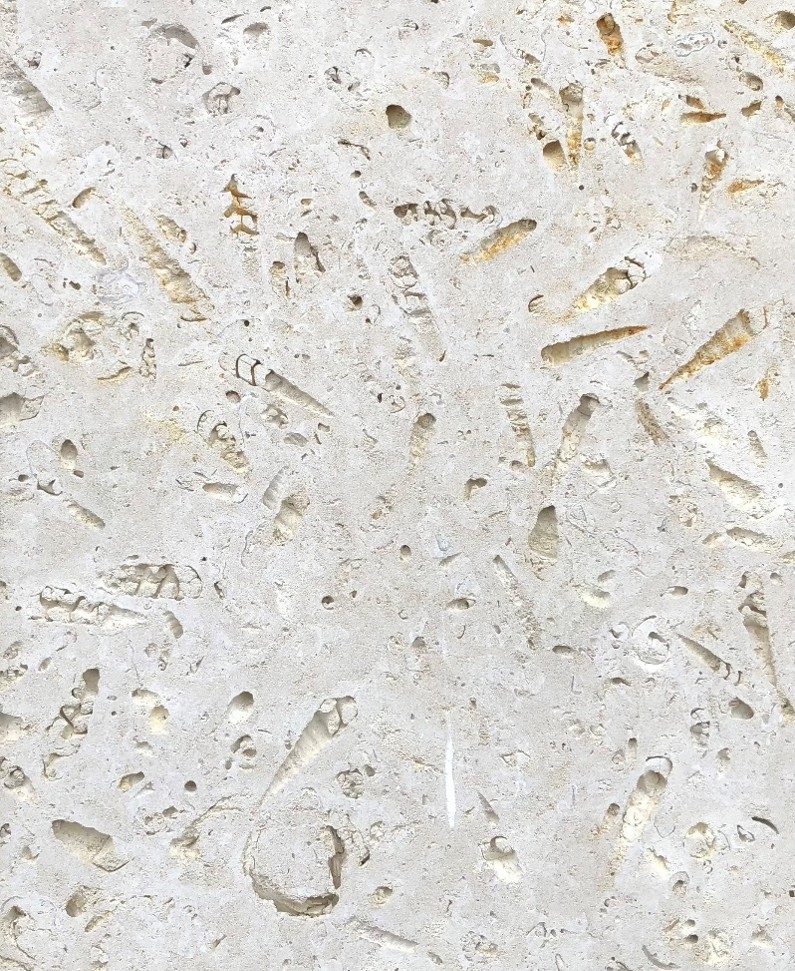
As groundwater moves through the stone, it can carry minute quantities of this iron in solution. Portland Stone is a natural material and, like many limestones, contains small fissures, joints and fossil related voids through which groundwater may slowly migrate. Where groundwater reaches an open feature such as a natural joint, or in the case of Roach stone, a void associated with an Aptyxiellia or Trigonia fossil, some evaporation may occur.
When groundwater evaporates, dissolved minerals are left behind. Over extended periods of geological time, repeated cycles of water movement and evaporation can result in the gradual concentration of naturally occurring iron rich minerals on exposed surfaces within the stone. These minerals typically form localised rusty, golden brown or honey coloured markings known as limonitic surface deposits.
This process is entirely natural and is not unique to Portland Stone. Similar mineral deposits occur in many types of rock throughout the world and are formed by the same geological mechanisms. The deposition of minerals from groundwater is also responsible for the creation of familiar cave features such as tufa, stalactites and stalagmites. In each case, minerals carried by water are slowly left behind as the water evaporates, creating visible evidence of geological processes that may have been occurring for thousands, hundreds of thousands, or even millions of years.
The appearance of limonitic surface deposits can vary considerably. Some may be visible as subtle honey coloured patches, while others may appear as more distinct rusty markings associated with fossil voids, natural joints or other pathways through which groundwater once travelled. These variations are a reflection of the natural history of the stone and contribute to the individuality and character of each block.
Importantly, limonitic surface deposits are a superficial characteristic and should not be regarded as a defect. They do not indicate deterioration, contamination or any reduction in the quality, durability or performance of the stone. Their presence simply reflects the movement of mineral rich groundwater through the limestone at some point during its geological history.
Experience with Portland Stone across a wide range of projects has shown that limonitic surface deposits often become less visually prominent once the stone is removed from the ground and exposed to natural weathering conditions in service. Exposure to daylight, rainfall and the natural ageing processes that affect all building stones can soften their appearance over time, allowing them to blend more readily with the surrounding stone surface.
Limonitic surface deposits are therefore best understood as a naturally occurring feature of Portland Stone, formed by long term geological processes and preserved within the material until it is extracted from the ground. As with many natural stones, these characteristics are part of what makes each piece unique and provide a visible connection to the geological history of the landscape from which the stone was formed.
As a fourth generation family business, Albion Stone takes pride in its knowledgeable and dedicated workforce. By combining traditional craftsmanship with modern manufacturing techniques, we produce Portland Stone of the highest quality while minimising our environmental impact.